
PlatformRanking
Candidate ranking against your scorecard.
Every clinician scored against your scorecard, evidence written out. You decide.
 Kandi · Ranking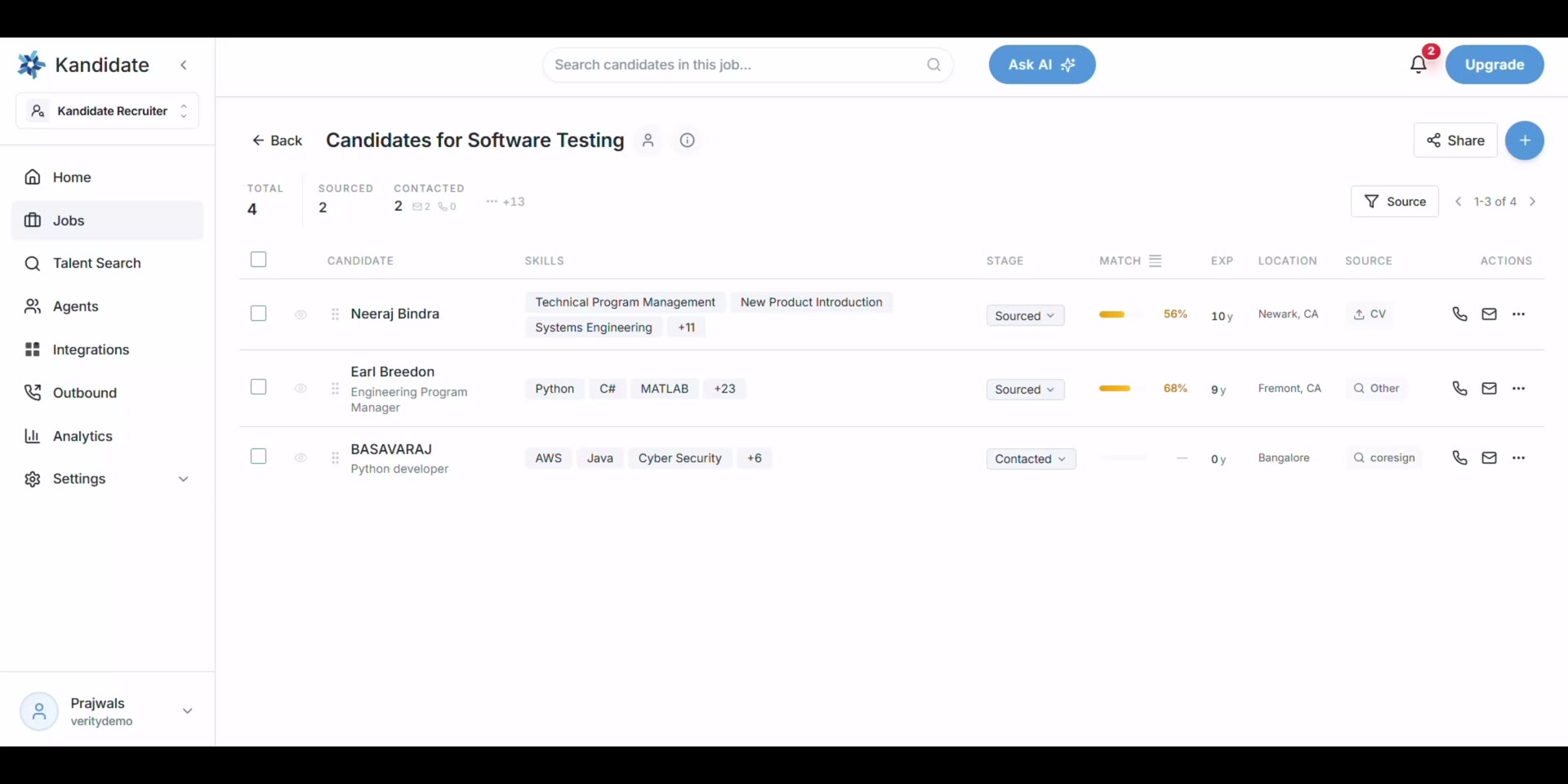
How it runs
Scorecard first
Ranking refuses to run without one.
Weigh
You set an importance of 1 to 5 on every criterion.
Evidence
Each requirement: met or missed, with the line that proves it.
You decide
It ranks and explains. Nothing is rejected on your behalf.
Built in
Meaning, not keywords
"Cardiothoracic theatre" matches a brief that says "cardiac OR".
The score decomposes
Skills, experience, location, openness. No black box.
CVs too
Uploads score on the same bar as sourced profiles.
Questions buyers ask
Can I change the criteria after a run?
Yes. Edit the scorecard — add a criterion, change its importance — and re-rank; the pool doesn't need re-sourcing.
Does the score go back to my ATS?
Not yet. Scores and scorecards live in Kandidate today; the scorecard view is built to be forwarded, and ATS write-back is on the roadmap.
Does it read CVs as well as sourced profiles?
Yes. Uploaded CVs are parsed into the same structure and scored against the same scorecard, so applicants and sourced candidates are comparable.
What is the openness signal?
An estimate of how likely a candidate is to move right now, based on tenure and role-change patterns. It's one of the smaller inputs to the overall score and the breakdown shows it on its own line, because willingness and suitability are different questions.
See it on one of your own roles.
Bring a clinical role. See how the platform handles sourcing, outreach and initial screening for your team.